Monday, 29 April 2013

Player Viewpoint - Dartford FC winger Ryan Hayes


Not many people would have put money on Dartford FC finishing 8th in the Conference National having won promotion last season. But the fact remains that they are now the highest ranked part-time side in the country.


Some unbelievable performances both home and away allowed the Darts to notch up a commendable 66 points during the 2012/13 season, taking the scalps of some formidable opponents along the way.

A televised home win against eventual league champions Mansfield, as well as strong victories over Newport County, Wrexham and an emphatic double over Luton Town were chief among the highlights of what has been an exciting and confidence-boosting season.

All of this was nicely complimented by reaching the semi-finals of the FA Trophy; only to be narrowly eliminated by league rivals Grimsby Town (who were defeated in the final by Wrexham).


(Image: Press Association)

A player who had a massive part to play in all of this was Ryan Hayes.'Ryano' has been a mainstay and firm fan favourite at the club since joining as a 20-year old from Kent League side Slade Green in 2006.

Chipping in with his share of crowd pleasing left-foot belters and laser-guided assists, he has gone from strength-to-strength as a player.

Now 27 and an experienced head when it comes to promotions - three in five seasons - Ryano tells me about his career, the Darts excellent campaign and what he thinks the club can achieve next...


Did you ever believe that the Darts would have finished as high as they have?


We always knew that if we stuck together and competed, we had enough quality to beat anyone on our day.

As players, how has juggling work with travelling and training affected not just your performances, but your lives?


Very hard! I used up more than a week’s holiday with midweek away games, as I work nights. With the training side we managed it well. If we were far away on a Tuesday we would normally have the Thursday off, or just have a very light session. With my home life it was hard also. Having a young family - two young children and wife - it would be difficult sometimes being away the whole weekend and not seeing them does affect you a little, but my family totally understand my love for football.


Did you ever think that when you were playing in the Kent League you’d be on the brink of full-time football just a few short years later?


Not for one minute! I always had confidence in my ability, but when I wasn't wanted at Thamesmead I went to Slade Green just to enjoy it and play with my mates. But to be so close to full time football is unreal, really.

How does the Conference compare to the Ryman North/Ryman Premier/Conference South? Was it a big step up?


It's miles and miles ahead of Ryman Prem and North. The Conference South was a hard league, but the Conference is the best league outside of professional football and if you have an off day, you get punished and in big way. We've been beaten not by better sides, it's just if you make mistakes at this level you end up on the back foot. 

What do you think has been the key to the team’s success? Is there anything that you think sets you apart from the full time teams?


Our team spirit is unreal. Our togetherness in and out of football is better than most, I would think. We work so hard for each other and as a group everyone gets on very well. Also, there is lots of quality in our team. I personally think that we have the best centre-midfield partnership in non-league football with Elliott (Bradbrook) and Champs (Tom Champion). They have been unreal for the last 3 years.

What would you say has been behind your own success - proving yourself at every level you've played?


Good family and friends around me. I love to prove people wrong. I always said when I left Thamesmead I was good enough, I just hope people that told me I wasn't good enough back then realise now that maybe they made a mistake. Playing in the Ryman Prem I was very lucky to play in a great team. Conference South I did find hard personally - for what reason I don't know. I went through a bad stage where changing jobs didn't help and I wasn't fit if I'm being honest with myself.


What is it like playing under Tony Burman? What is it you think he has done to get the best out of the team?


It's great to be fair to him. As much as he rants and raves at me, I know that he has so much belief in me. I do owe the gaffer a lot for where I am now - and I do get away with murder! But if I'm not on it I do get the "hair dryer treatment". He gets in good lads that are good players. Being here so long, I've seen him improve loads.


What do you and the players think is possible next?


It's going to be harder next season without doubt, but if we can get in a few good players to improve us we know we can compete and beat anyone. I personally think we are 3 good players away from being a top team and competing for the play offs.

Tuesday, 2 April 2013

The Precarious Position of the Football Manager

From bottom to top in football, managers are the all-too-frequent casualties of under-performance on the pitch. You would never expect Fernando Torres to be handed his P45 for not scoring enough goals. Or Joe Hart having his contract terminated for not keeping a single clean sheet in 10 games. It must be both unsettling and confusing therefore when a manager loses his job within a matter weeks of being handed it.


Just yesterday evening, Neil Warnock “parted company” with Leeds United. The club languishes at mid-table after losing 2-1 to Derby County on Easter Monday. They have been stranded in The Championship – either side of an appearance in League One between 2007 and 2010 – since relegation from the top flight in the 2003-04 season. That’s almost a decade of underachievement, on the back of financial mismanagement and executive confusion.

A pattern of “revolving door syndrome” is reaching almost laughable levels at another former Premier League mainstay – Blackburn Rovers. A period of exactly six months at Ewood Park has seen three different managers at the helm. Growing discontent, verging on hatred, for the club’s owners among Rovers fans is not aided by the Venky’s habitual hiring and firing policy.

Steve Kean was the first of the three to lose his job after two years in charge. Former Rovers player Henning Berg – part of the famous Premier League winning side of 1994/5 – was appointed, then inexplicably sacked again just 57 days later. His successor Michael Appleton lasted just ten days longer than that, leaving the club with a caretaker manager in Gary Bowyer.

Fans and neutrals alike have gone from dismay and disgust to acceptance and expectation of this kind of activity. A perhaps even more confusing scenario is currently being played out at League One’s Stevenage Borough. The club have sacked Graham Westley twice already, most recently in March of this year after a run of 14 defeats in 18 games. They have now re-appointed him, with his first game back in charge ending in victory over Hartlepool.

All of the above points to one sad, seemingly obvious fact: the position of manager at any professional football club is a fragile one. Directors and chairmen can sit behind the desk and the chequebook for decades without so much as a sniff of the exit door, yet when it comes to a fall guy they point straight to the ‘gaffer’. This brings me back to my initial observation about where the blame lies.

£50m-worth of Spanish centre-forward or a first choice international goalkeeper, both of whom take home a substantial pay packet each week. In between these we have nine other accomplished professional players that have represented their countries in some form. No wins in five games and the owners declare a crisis and go in search of “a change” in approach. Does he replace his misfiring striker, greasy palmed keeper or piano-carrying centre half? The simple answer is ‘no’.

It takes something far more serious for a player to immediately lose his job. Failing a drugs test will sometimes do it, as evidenced by Adrian Mutu. You can also get sent to prison. It’s safe to say, that in a normal place of work, if you simply don’t deliver on your duties you will quite easily be shown the door.

In the football world, the same is true only for the manager.

Friday, 22 March 2013

The Hammers go Olympic: Is it the Right Move?


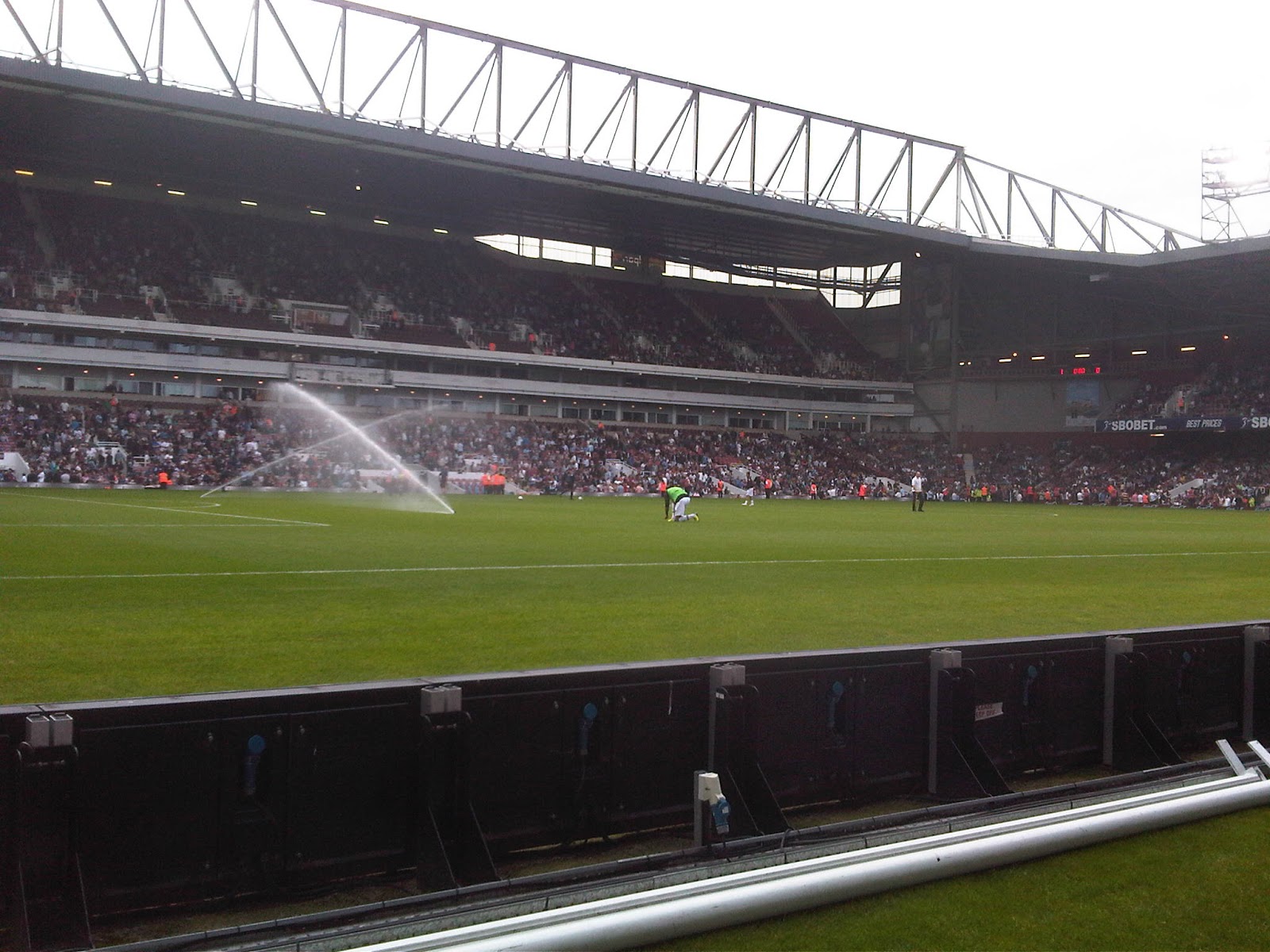
It’s been a long time coming; dividing opinions among politicians, football clubs and fans. West Ham United have finally been named as the anchor tenants of the Olympic Stadium in Stratford. The Hammers will move into their new home in August 2016, after the venue will have undergone between £150-£190m of investment and alteration.

The main concern for fans was the fact that they would be so far from the pitch. That concern was not allayed by attendance at the Games last summer, or when watching from their sofas – it did appear to be a fair way back from the action.

However, the arguments for moving have been strong and as a fan, I must say that a move is clearly the way forward should it be economically viable. West Ham chairmen, Davids’ Gold and Sullivan, along with Chief Executive Karren Brady, have made extremely convincing cases for jumping ship from Upton Park.

Along with retractable seating to ensure that fans can enjoy the best views possible while keeping the track, a seemingly sincere pledge to lower the cost of attending games will be the telling factor for unimpressed followers.

The Boleyn Ground has been the club’s home since 1904, allowing local businesses in what is an otherwise deprived area to stay afloat. Although the on-pitch exploits haven’t been enormously fruitful at any point, it has nonetheless given East Londoners a sense of identity and community rarely seen with other top clubs.

So why do I think that a move is the right way to go? I’d say it comes down to a few things:

(1)  Any other prospective move is not even close to being on the cards. The financial condition of the club,though quite visibly more stable since the current administration have stepped in, is far from that enjoyed by the cash-rich big boys (we all know who they are). This means staying and developing the Boleyn, which has its limits both legally (planning permissions etc.) and when it comes to money.

(2)  Accommodating demand from fans.It’s not exactly splashed across the papers, but the waiting list for season tickets has always been congested. An almost two-fold increase in capacity would mean that young adult fans with some disposable income can buy theirs and become the next generation of die-hards.

(3)  Higher attendances =lower-cost football.It’s been a key lure for a move to the Olympic Stadium, but the increased capacity from 35,016 to 54,000 fans would mean significantly lower ticket prices. The challenge for the owners will be delivering on this promise

(4)  A boost to the club’sprofile.The move will bring us into the top-five attended clubs in the Premier League (should we remain there for the foreseeable future). A modern, all-purpose facility is also what the club badly needs if it is to keep up with its London neighbours, as well being able to facilitate regular European football - should those glorious days ever come! It’s all well making space for the fans, but providing something to cheer about comes with the territory.

(5)  Provides a realistic hope of avoiding a ‘White Elephant’. To look at it from a practical point-of-view,the last thing anybody wants is a fantastic venue laying waste. The O2 Arena proved to be the saviour of the Millennium Dome, but only after 6 years of it decaying on the riverside. Allowing West Ham to move in, paying £2m a year for the privilege, makes perfect sense.

A predictable wave of criticism and opposition will continue to fall over the move– former sports Minister Richard Caborn has already added to the protests. The diplomat in me empathises with clubs like Leyton Orient, who will inevitably suffer the effects of reasonably priced Premier League action on a couple of miles down the road. That said – who knows whether either of us will be in the same position come-2016? 

Not to be misunderstood – the heart often pushes me towards wanting the club to stay put, but I think the change is crucial. Now under the control of business-savvy multi-millionaires and already attracting established players, the club will (hopefully) continue to grow and flourish from bottom to top.

Forever living in the past should be replaced with looking positively to the future. What better way to encourage that than by upgrading its headquarters?

Thursday, 25 October 2012

Leap of a Salmon: The Stuttered Rise of Big Andy


 Source: Alex Livesey/Getty Images Europe

From his early days as a young flaxen-haired prodigy hailing from the black and white region of the North East, Andy Carroll’s story has been followed with a keen eye in the football world. The promising academy product made a very big mark in Newcastle, particularly by scoring a hatful of goals in their very brief period spent in the Championship. The Toon Army made their reluctance to sell him known, but when Liverpool bankrolled an “offer he couldn’t refuse”, Mike Ashley decided to cut his losses and fill the club’s purse.

Undeniably a force to be reckoned with in the air, and carrying the playing attributes of an old-fashioned centre forward (a la Duncan Ferguson and Chris Sutton), “Big Andy” has often attracted attention away from his obvious ability on the field with his less than desirable behaviour off of it. His recent loan move to West Ham was met with positive responses overall, but the dissenting voices were nearly all female. His headline grabbing antics in October 2010 appear to have gone some way in putting a bad taste in supporters’ mouths; I refer of course to Andy being charged with assault on his girlfriend – part of his punishment being to live with now again captain and close friend Kevin Nolan.

However, despite the naivety of youth and misguided behaviour, his criticism has more recently focussed on his football. His somewhat unfair price tag of £35 million, coupled with the task of filling the boots of one El Nino, piled incredible pressure on him before he had even kicked a ball. He was quoted in several newspapers as saying that he did not want to leave Newcastle, the club he had been with since he had first started sowing the seeds of that famous ponytail. Needless to say, his game took a severe knock from the moment he put pen to paper in the board room at Anfield, and is still trying to prove to the world that he can live up to the cash spent on him.

His efforts have not been helped by the phenomenon that is Luis Suarez, who has proved to be prolific, exciting, passionate and hungry. Controversy aside, the Uruguayan is already a Kop hero, and has received fan and club backing through thick and thin. Carroll on the other hand has been subjected to much harsher treatment it would seem, being judged (as are all strikers) on goals scored and trophies won. It may be, however, that Liverpool’s bitterness for him is an unfortunate consequence of a dry spell of both trophies and European football. Changes in regime at Liverpool, and an almost inexplicable disregard of Carroll’s usefulness by new manager Brendan Rodgers, have all come at a time when the once Geordie prodigy should be developing into the fantastic and pivotal player that he will hopefully become.


As a Hammers fan, I think his addition to the squad (albeit probably only until January) has been a revelation for the club. It was a major coup for the chairmen and the manager, as not only did it add some much needed raw quality, but it was real statement of their intent. A continuing battle to acquire the use of the Olympic Stadium along with the aim of consolidating the club’s place in the world’s greatest league was very nicely complimented by convincing the striker to sign.

On early assessment, albeit without goals as of yet, he is fantastic player. He adds something to an already physical squad, and as soon as he enters the field of play, the captain alone is afforded freedom to attack more frequently. An almost telepathic understanding between Carroll and Nolan, nurtured under the watchful eye of Big Sam at Newcastle, has already bred some visible quality. A new challenge for Carroll, perhaps being motivated by a lack of striking options currently being enjoyed by Liverpool, will give him the desire to perform.

It cannot be forgotten that he is still only 23 years of age; with at least another decade of top level football should he stay fit and healthy. With an already bright England career in the making, it will surely only be a matter of time before he, and everybody else, will realise his potential. 

Wednesday, 17 October 2012

Getting the Green (Flood)Light – Environmental Sustainability in Football


Among the many challenges that face football clubs in executing a successful business model, corporate and political pressures have added another; consideration for their environmental impact. The sport leaves an extraordinarily large carbon footprint, using an enormous amount of electricity, gas and water. In order to adhere to the environmental policies of football’s governing bodies alone, clubs and other related businesses must take energy use and waste into account.


Improving the sustainability and decreasing the negative effects of delivering football to the public have been extremely high on the agenda for a number of years. High profile figures in the game have made excellent strides in promoting environmentally friendly construction and maintenance of football stadia around the world. Former Manchester United defender and now England Coach Gary Neville has used his profile, experiences and interests in property development to try and “influence and change peoples’ attitudes” towards the environmental impact that they may be having in their everyday lives. In fact, Neville founded Sustainability in Sport (SIS) with Dale Vince OBE, which looks to raise awareness of the environmental impact that football has.


SIS presents three club case studies: Forest Green Rovers; Manchester United, and; Dartford FC. All three clubs have gone to great lengths to reduce their carbon footprints and to reduce the waste produced by their operations. The latter club mentioned here is in fact my local side, with their ultra-eco-friendly ground Princes Park being opened in 2006. Since then the club has enjoyed great success on the pitch - gaining three promotions in 5 seasons to take them up to the National Conference – but have also cemented themselves as one of the most environmentally friendly and sustainable football clubs in the United Kingdom. The club has gained high recognition for having built “an ethical stadium with water recycling, bike racks, grass roof and solar panels”. In addition to other methods of reducing environmental impact, such as low energy lighting, encouraging the use of public transport, waste efficiency and recycling (such as that employed by Man United’s “Red’s Go Green” initiative), advertising and promotion within the game leans very heavily toward saving and reducing the use of energy; helped in no small part by the sponsorship of the Football League by npower.

For such a global sport to be viewed as an ethical one, FIFA have made very visible steps to ensure that football is leading by example in energy and environmental policy. Its 2004 Green Goal Legacy report detailed the commitments and adjustments made in respect of logistics and stadia for the 2006 World Cup in Germany, making a commitment to reducing the impact had by large scale tournaments. The roof of Kaiserslautern stadium alone was equipped with a 6000 square metre photovoltaic plant, capable of generating 720,000 kWh of electricity per year. It was estimated that that the tournament would consume 13 million kWh of electricity across all of its sites during its four-week duration – an astronomical figure. This was offset beforehand however by injecting the very same amount of “green” energy into the normal German supply network.

In addition to the work of the largest clubs and bodies, amateur football is making gradual progress in contributing to the wider efforts of the sport, taking responsibility for their potentially harmful impact on the environment. After all, changing rooms and showers need to be sufficiently warm in the long winter playing period, as do the accompanying cups of half-time tea – all of these elements on a Saturday afternoon or Sunday morning across the country begin to leave a mark. By making small changes over a season, those clubs with their multitude of age groups and reserve sides will be able to not only save precious funds, but count themselves among the ever growing throng of energy conscious sports clubs across the globe. 

Friday, 12 October 2012

England – Why can’t we hammer the Minnows?


Season upon season, one qualifying campaign after another, the senior England national team are drawn in a group with a country labelled as the resident “whipping boys” – so why can’t we ever seem to do a demolition job? The Germans, for example, are well drilled in this task, seemingly pulverising any side placed in the bottom ten per cent of the FIFA World Rankings. Even though it appears that England seem a far more positive and hungry outfit under Roy Hodgson, I would rest far more easily should I be confident that England could sweep part-time nations aside with relative comfort on a regular basis.  


The Moldova’s, Andorra’s and San Marino’s of this world compete heroically against the exceedingly well paid superstars of Spain, France and Brazil et al. They will of course be routinely beaten – and beaten well – when the bus that they have parked eventually gets a puncture. So why then, when England are ranked so highly in world football, do we never seem able to put seven or eight goals past sides that are no more able than a part time team from the non-league? In fact, among the opponents walking out at Wembley tonight were bank clerks and teachers – most likely earning in a year what Wayne Rooney earns just lacing up his boots for training.

I have to admit here that I took the gamble of beginning this article on around the thirty minute mark, with the score at 0-0, but it turns out that I haven’t, unfortunately, been proven wrong by the Three Lions. Andy Townsend pretty much summed up my thoughts in his commentary on 59 minutes: “You have to wonder, if this was a Spain, if this was a German; how many would they be knocking past [San Marino]?” There seems to be a latent inability to completely and efficiently dominate smaller sides where a game such as this should be done and dusted by half time. Despite the absolutely dominant statistics collected over the course of the game paint a convincing picture, actually watching the game makes for a supremely frustrating hour and a half. Score lines such as that enjoyed by the Germans six years ago would make for far more pride-laden reading tomorrow morning, with Rooney or Welbeck “doing a Podolski” and grabbing four or five goals each.

As it stands, both Rooney and Welbeck have scored a brace a piece on 70 minutes – is it wrong of me, or any England fan, to think that this is insufficient against a team ranked 202 places below them? The Ox has just scored his first England goal on 76 minutes, by the way – a beautifully curled effort into the top right of the goal. Yet still I feel fairly unimpressed with what has been a fairly flat affair – 5-0 up or not. 

Not known for his love of all things England, Roy Keane took only six or seven seconds to sum up England's performance at half time - suffice to say it wasn't exactly positive. I must concede, however, I do not very much like joining in with the brigade of fans that refuse to say anything remotely positive about the national side. With that, it must be observed that the starting line up was wholly inexperienced at international level and not so used to playing together. They have spent 90+ minutes trying to break through a frustrating blue wall of 10 players who, as Keane described, were "so short technically", and a 5-0 win in any event puts us top of the group with a little help from Moldova

It's another job done, however, so perhaps I should stop being so picky over the details. Still, it would be nice if we could hit double figures where we occasionally have the opportunity...

Wednesday, 10 October 2012

Home & Away – The Importance of Transport in Football


As one of the most keenly participated and followed sports in the world, transporting football fans and players from A to B is an essential ingredient in contributing to its cultural and commercial success. English Premier League teams, for example, often travel with anything from a couple of hundred to several thousand fans to away games. These figures are fairly consistent when taking a glance at football league statistics over the past four seasons, and suffice to say the vast majority of die-hard fans will show a preference for the “away day” over a solitary car or train journey.

Old Trafford

On a typical Saturday afternoon, the motorways and streets lining the football grounds of England are teeming with coachloads of jersey clad ladies, gentlemen and minors, willing to back their side through promotion and relegation. The weekends which they have long lived for are made all the more enjoyable, and achievable, by the coach and minibus drivers willing to scour the countries tarmac network, kept company by the heartfelt song and chant of six or seven-dozen passionate supporters. At the same time, the trains are awash with similar sights, as are the saloon cars filled with mums, dads and children indoctrinated with the colours, history and passion of their ancestors’ great club.

From the very highest level of the game down to school and university teams, travel to and from matches is what makes the sport both accessible and inclusive; a bus full of excited teammates acts as a marvellous adrenal stimulus. That is why, in order for the professional game to be stacked high with dedicated and skilful stars, it is vital that the youth and academy teams of clubs across every standard have their physical and mental abilities complemented subconsciously by a sense of unity and professionalism.

This attention to detail at granular level sets the future stars of the sport in excellent stead for when they eventually, and hopefully, become established and successful professional sportsmen and women. Professional clubs pay particular attention in ensuring that their young academy prospects disembark shiny new coaches and minibuses and are clad with crisp and laundered tracksuits, enabling any side to have an automatic psychological edge over their opposition. The very same ideal, as I’m sure others would agree, applies to how your team enters a school, university or amateur football club ground.

Be it with your fanatical parents, team scarf adorning the rear window and garish bumper sticker peeling away, with your cash-rich club in a state of the art super coach, or upon an economy class locomotive (once the custom of a certain group of supporters from the East End of London), public and private means of transport are integral cogs in the footballing machine. Its success, particularly with regards to revenue generated by gate receipts, is largely down to the ability of fans to travel to matches. It is, in fact, one of the only things that will remain a constant in an ever changing environment for the sport.